More than 50 years ago, as a young farmer in my third season, I attended a meeting called to address a serious issue—our inability to move grain efficiently. Storage was limited, rail transport was insufficient, and export ships sat waiting while growers paid the cost.
One of the senior farmers, Cliff Dodds, made a point that has stayed with me ever since:
The best grain storage is on wheels. If it isn’t moving, it isn’t being marketed.
That simple observation became what I have long referred to as Dodds’ First Principle for Profitable Grain Production: keep the grain moving away from the combine.
Despite decades of change across agriculture, that principle remains as relevant as ever.
Everything Has Changed—Except the Bottlenecks
In the years since, the scale of grain production has increased dramatically. Combine capacity has doubled repeatedly. Yields have improved. Farm sizes have expanded. Truck capacity has grown, and harvest speed has accelerated.
At the same time, costs have risen, labor has become harder to secure, and penalties for weather-damaged grain have increased.
Yet, despite advancements in grain handling equipment, the weakest link in the harvest chain remains unchanged: the movement of grain away from the combine.
Most harvest delays still occur not because of machinery failure, but because the system downstream cannot keep up.
The Evolution of In-Field Storage
Farmers have always adapted when systems fall short.
In the 1960s, temporary on-ground storage structures were common—basic, labor-intensive, and far from ideal.
The 1970s saw the introduction of small towable steel bins. While more practical, they required significant labor to move and operate. As harvest capacity increased, so did the number of bins needed in each field.
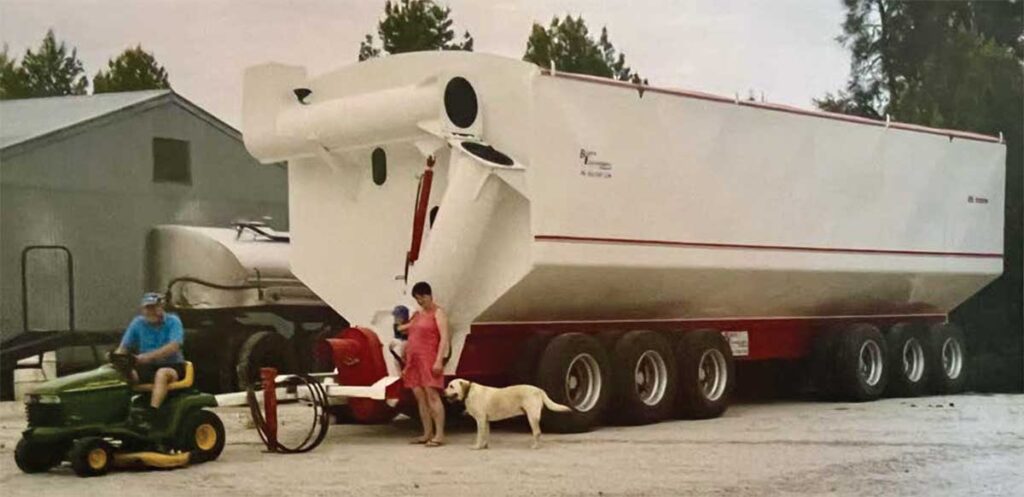
By the 1980s, grain carts became the dominant solution, growing rapidly in size. Today’s carts can exceed 2,000 bushels and require high-horsepower tractors to operate efficiently.
While effective, this approach comes at significant cost—in both equipment investment and labor requirements.
The Role of the Mother Bin
The introduction of the Mother Bin addressed a different part of the problem.
Rather than replacing existing grain handling equipment, it improved how each component worked together.
A Mother Bin functions as an in-field surge bin, positioned between grain carts and trucks. Its value lies in reducing downtime and improving flow:
- Grain carts unload quickly and return to the combine without delay
- Trucks load efficiently when they arrive, without needing to match combine timing
- Combines continue operating without interruption
This change in flow reduces pressure across the entire system.
The focus shifts from matching capacity to maintaining continuity.
Efficiency Without Adding More Equipment
In today’s economic environment, simply adding more machinery or labor is not always viable.
Additional trucks, operators, or grain carts represent a significant capital and operating expense. For many growers, duplication of equipment is not a practical solution.
The Mother Bin offers an alternative by improving the efficiency of existing resources.
Instead of increasing fleet size:
- Grain carts spend less time traveling long distances
- Truck turnaround becomes less critical to combine operation
- Labor requirements are reduced or better utilized
- Equipment operates closer to its intended capacity
This is not about increasing speed, but about removing inefficiencies.
Why System Balance Matters
A harvest operation is only as efficient as its slowest component.
Grain elevators have increased receival speeds. Combines unload faster than ever. Trucks have expanded in capacity where regulations allow.
However, public road limitations restrict further gains in truck size and weight. Grain carts are nearing their practical limits due to compaction and power requirements.
On-farm storage has expanded, but introduces its own inefficiencies—double handling, delayed marketing, additional labor, and potential quality risks.
This leaves a gap in the system: maintaining continuous flow between field and transport.
The Mother Bin fills that gap.
Practical Impact in the Field
In practical terms, the presence of a Mother Bin changes how operations are conducted:
- Grain carts operate on shorter cycles, focused on supporting the combine
- Trucks operate independently of field timing constraints
- Harvest continues even when minor delays occur downstream
- Fewer interruptions lead to better use of available harvest windows
For larger operations, multiple Mother Bins can further improve traffic flow and efficiency, particularly where several combines are operating simultaneously.
A Necessary Adjustment in Process
To gain the full benefit, some operational practices may need to change.
In many cases, truck loading becomes a dedicated task rather than an extension of the grain cart operator’s responsibilities. This allows grain carts to remain focused on keeping combines running.
In higher-yield environments, a dedicated operator managing the Mother Bin can further streamline the process, especially where truck volumes are high.
These adjustments are relatively small but contribute significantly to overall efficiency.
Conclusion: Keeping Grain Moving
After decades of observing harvest systems evolve, one conclusion remains clear:
Most inefficiencies occur when grain stops moving.
The Mother Bin does not replace other grain handling equipment. It enhances the system by maintaining flow, reducing downtime, and lowering reliance on additional labor and machinery.
In an environment where costs are rising and resources are constrained, improving efficiency within the existing system is often the most practical solution.
Dodds’ principle still holds true today. The profitability of grain production depends not just on yield or machinery size, but on how effectively the entire system keeps moving.
And in that respect, the Mother Bin has become an essential part of modern grain handling equipment.